
Defining a new benchmark for three-way frequency: German Zero Point GZRC 165.3, reshaping market perception with sound quality strength
In recent years, the car audio modification market has shown a prosperous scene, and all kinds of speaker brands have sprung up. They advertise different musical styles-some emphasize the precision and calmness of German, some focus on American enthusiasm, and some pursue British warmth and delicacy. All kinds of seemingly advanced labels such as “imported original goods”, “top technology” and “master tuning” are dizzying, among which there are some “foreign brands” that are difficult to distinguish between true and false, which makes the majority of riders feel confused and confused when choosing. In an environment full of information, how to clear the fog and touch the real core of the product? The most direct and effective way is to visit a professional audition room in person, distinguish the essence of sound through the most primitive senses-“listening” with your ears, “observing” the details of the process with your eyes, and “touching” the texture of the material with your hands, so as to make the most objective and intuitive comprehensive evaluation, so as to make a final decision and find a good voice that really suits you.
Among many brands, the GZRC 165.3 three-way speaker set owned by Germany’s Ground Zero seems to be born with the genes of excellent sound. Its design philosophy is distinctive from the root: all its units (treble, midrange, midbass) boldly adopt a nominal impedance of 3 ohms, compared with the uncommon 4 ohms or 8 ohms. This low-impedance design contains profound electroacoustic principles. A lower impedance means that the internal resistance of the coil is smaller, and at the same input voltage, more current will flow through the voice coil, resulting in more electrical force driving the diaphragm movement. Reflected in the actual listening experience, the most obvious advantages are higher sensitivity and easier driving characteristics. It can respond more sensitively to the subtle changes in the voltage output of the power amplifier, making the dynamic fluctuations of the sound more vivid and the details easier. This feature makes it have relatively low requirements for driving power, and even in the official design concept, it can be considered to be directly driven by the original owner engine, thus providing an attractive high-quality entry plan for car owners with limited budget or who want to simplify the system. Looking at the current market, the Zero Point GZRC 165.3 is one of the very few high-end three-way systems that dares and can use this as a selling point, which undoubtedly reflects the brand’s strong confidence in the core performance of its unit.
Zero Point GZRC 165.3
Comparison of appearance design and process details
Tweeter Comparison


Rainbow SL-C 6.3 tweeter unit: Its tweeter adopts silk soft dome diaphragm, which is a classic choice for pursuing soft and resistant high frequencies. The exterior design is relatively traditional and pragmatic.

Zero point GZRC 165.3 tweeter: It adopts a patented composite material diaphragm, which aims to take into account high-frequency extension and detail analysis. The appearance design is more modern, and the heat dissipation structure has also been specially considered.

Frontal view of the midrange unit. It is worth noting that the zero-point midrange unit on the right is equipped with an exquisite metal protective mesh as standard from the factory, which not only improves the aesthetics and integrity after installation, but also provides certain physical protection in actual use. The rainbow midrange unit on the left is not equipped with this kind of net cover as standard, and the diaphragm is directly exposed after installation, making the style more “naked” and professional.


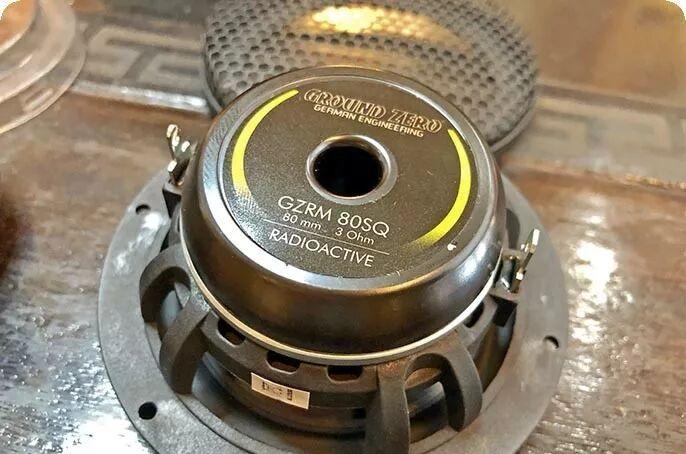
The back of the zero-point midrange unit is clearly engraved with the model number and key electrical parameters, which reflects the consistent rigor of German manufacturing. Although the high-performance neodymium magnet used in it is small in size, it can provide strong magnetic flux density, which is conducive to improving the efficiency and control of the unit.
The structure of the basin frame (that is, the skeleton supporting the diaphragm and voice coil) of the bass unit between the two is significantly different. Zero point GZRC 165.3 adopts an integral die-casting aluminum alloy basin frame. This structure is extremely rigid, which can effectively suppress harmful resonance during work and ensure a more linear piston movement. At the same time, the precise processing technology also brings excellent visual texture. In contrast, the basin frame design of Rainbow SL-C 6.3 adopts different materials and structural ideas.



Let’s compare the mid-bass unit diaphragms of the two. Both of them unanimously chose aluminum alloy as the diaphragm material, which is due to its advantages of strong rigidity, light weight and fast transient response. The difference mainly lies in the surface treatment process versus the coating color, which can have a subtle impact on the timbre.

The magnetic circuit system is the “heart” of the speaker. We took precise measurements: the magnet diameter of the bass unit in the Rainbow SL-C 6.3 is about 88.79 mm.

The magnet diameter of the zero point GZRC 165.3 mid-woofer unit reaches about 95.61 mm. Larger magnets usually mean stronger magnetic force and better control potential, especially when it comes to large dynamic performance.

In terms of effective vibration diameter of diaphragm: Rainbow SL-C 6.3 is about 141.45 mm.

The zero point GZRC 165.3 is slightly larger, about 142.55 mm. Although the gap is small, it is also part of the overall design.

In the design of terminal blocks, the two also embody different concepts. Rainbow SL-C 6.3 adopts the traditional screw crimp terminal, which is stable and reliable and requires tool installation.

Zero point GZRC 165.3 uses in-line pure copper terminals and is equipped with protective caps. This design is quick and easy to connect, and the contact resistance may be lower, but it is necessary to ensure that the wires are firmly plugged in.

Through the above multi-dimensional and detailed comparison from sound quality style to physical structure, we can clearly see that German Zero Point GZRC 165.3 and German Rainbow SL-C 6.3, two three-way systems of the same level, are on the way to achieving excellent sound. On the road, different technical paths and expressions have been chosen. The differences between them exist objectively, and there is no absolute difference between them, but only differences in style and orientation. I hope this detailed comparison can be turned into a bright light, illuminating your choice and helping you find the only “soul mate” that meets your inner hearing desire in the complicated world of car audio.




You May Also Like

Flagship mobile concert hall | The new Highlander is equipped with the Japanese Feishi three-way multi-channel system, reshaping the immersive listening experience of the entire car with a seven-seat surround acoustic architecture

Acoustic evolution from passive to active: A record of in-depth modification of Honda Crown Road equipped with a zero-point two-way system