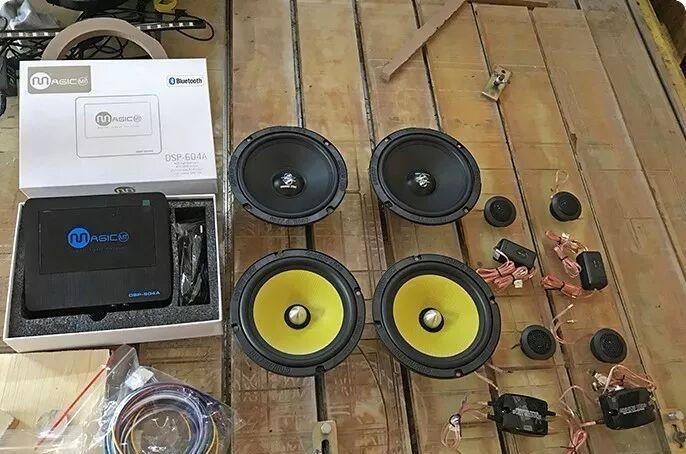
In-depth analysis of car audio power supply system: performance game and scientific choice between battery and capacitor
On the road of exploring car audio modification, many players who pursue sound quality will unanimously focus on the same core proposition-electricity when the system is built to a certain depth. They know that in the fundamental principle of “electro-acoustic conversion”, the quality of “electricity” is like the blood flowing in the human body, which directly determines the health, vitality and beauty of the final “sound”. However, when the problem advances from “knowing what is important” to “how to optimize”, many riders fall into the fog of choice. Common solutions on the market seem to go in two directions: one is to use multiple large-capacity capacitor arrays, which is amazing; On the other hand, it is more direct to install an independent “special battery for audio”. Which solution is the “correct way” to improve the power quality of your own system? This is often confusing and confusing.

To clear the fog and make a wise choice, we must fundamentally understand the different roles, working principles and performance characteristics of batteries and capacitors in the car audio power supply system.
1. Special battery for audio: a continuous and pure source of energy
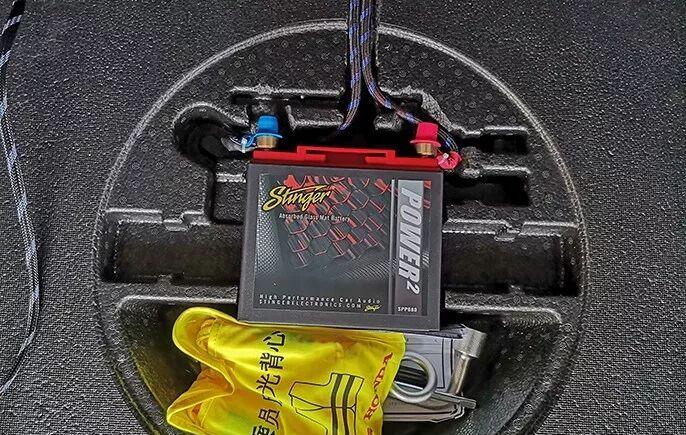
The essence of music is to convert electrical energy into mechanical energy (sound energy) that drives the speaker diaphragm through power amplifier. Therefore, electricity is not only energy, but also the original material of sound. Special batteries for car audio (usually AGM or lithium battery technology) play the most active and core dual roles of “power station” and “purifier” in this system * *.
It works in parallel or independently with the original vehicle starter battery, and its design is optimized for the high dynamic, instantaneous high current demands of audio equipment:
- Amazing instantaneous discharge ability:It can cope with the sudden burst of music in music and instantly provide hundreds of amps of current, ensuring that the power output of the power amplifier is not limited and the dynamics are not compressed.
- Extremely high energy purity:Due to the extremely low internal resistance and stable output, it can provide “clean” DC power with small ripple and small voltage fluctuation, effectively reduce the noise introduced by the power supply, and improve the background tranquility and detail resolution of the sound.
- Powerful energy reserves:With considerable energy capacity, it can stably power the high-power audio system for a long time when the vehicle is idling or static, without having to rely too much on the generator or worry about the original car battery losing power.
In short, the dedicated battery expands the total energy reserve of the system from the “source” and improves the power quality. It isProactive, fundamental reinforcement。
2. Large-capacity capacitors: fast, local energy buffer
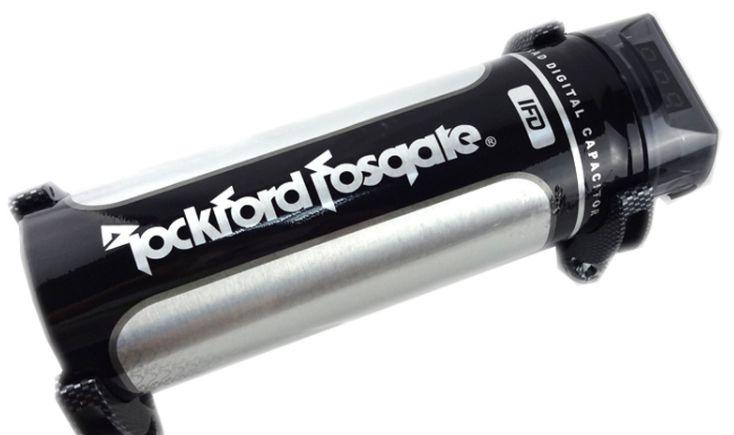
Capacitors are often vividly called “ponds” in car audio circles (from Cantonese regional culture). This metaphor tells its core function very aptly:Store electrical energy and quickly release it when needed。
Common car audio capacitors are mostly cylinders (such as 78 mm in diameter and 275 mm in height). It is usually mounted in the trunk and is brought in in parallel from the main battery in the engine bay via a multi-metre power cord. Its working principle can be compared to a “pressurized water tower” or “reservoir” connected to the main water supply pipe:
- Quick response:Capacitors charge and discharge extremely quickly. When the power amplifier instantly needs a large current (such as a strong bass drum beat), the capacitor closer to the power amplifier can provide this part of the “peak current” more quickly than the battery at the far end, making up for the response delay and internal resistance loss caused by long-distance cables, making the low-frequency transient performance simpler and more powerful.
- Filter voltage stabilization:To a certain extent, it can smooth the small fluctuation of power supply voltage and play a certain filtering role.
However, capacitors also have their inherent limitations:
- Passive storage, unable to “make water”:The capacitor itself does not generate energy, and the electric energy it stores comes entirely from the “instilling” of the front-end battery. When the system continues to be in a state of high power consumption, the energy stored by the capacitor will be quickly exhausted. If the energy supply of the front-end battery and generator is insufficient, the whole system will still fall into a “power famine”.
- Possible introduction of new problems:In the complex large-scale multi-power amplifier system, if the capacitor capacity is improperly configured or the total demand of the system is extremely large, the capacitor’s own characteristics may interact with the complex power supply network during the rapid charging and discharging process. In some extreme cases, it may aggravate the power interference between power amplifiers in different frequency bands, resulting in the decrease of control force, and even audible distortion, low-frequency drag (“tailing”) or sound confusion.
Fatal effects of power quality on system performance
The essence of a power amplifier is an energy converter. Insufficient or impure power supply will directly cause the power amplifier to faithfully and completely perform the amplification task:
- Power loss and distortion:When the peak current demand cannot be met, the power amplifier output will be “clipped”, resulting in serious distortion. This distorted signal is a “square wave” containing a lot of DC components, rather than a pure audio AC signal, which is a very destructive source of heat for the speaker voice coil.
- The culprit of burning the horn:In many cases of horn burning, the root cause is not that the power of the power amplifier is “too large”, but precisely that the power amplifier outputs distorted (clipped) DC power due to insufficient power supply, which leads to overheating and damage of the voice coil. Sufficient and pure power supply is the prerequisite for the safe and efficient operation of power amplifiers and speakers.
Conclusions and selection recommendations:
Through the above analysis, we can clearly see the positioning difference between the two:
- Specific accumulator for audioYes Strategic Energy Base, responsible for fundamentally improving the total energy reserve, power supply stability and current purity of the system.
- Large capacity capacitorIt is “Tactical Buffer Area”, mainly solves the problem of local and instantaneous current response speed, and is suitable for auxiliary optimization based on existing sufficient main power supply (such as upgraded large-capacity battery).
Therefore, for the vast majority of car owners who seek significant sound quality improvement, especially the high-power amplifier in the system:
Prioritizing upgrading or installing high-quality “audio-specific batteries” is the most effective investment to fundamentally solve the power supply bottleneck, ensure system safety, and improve the sound quality background and dynamic range. This seems more expensive than simply installing a capacitor, but it solves the source problem, and the sound quality improvement and system protection it brings are global and long-term.
Capacitors, on the other hand, are more suitable for specific scenarios where the original car power system is already quite strong and only need to make up the local instantaneous current of individual large dynamic loads such as subwoofer, or as the “icing on the cake” in top-level systems based on excellent batteries.
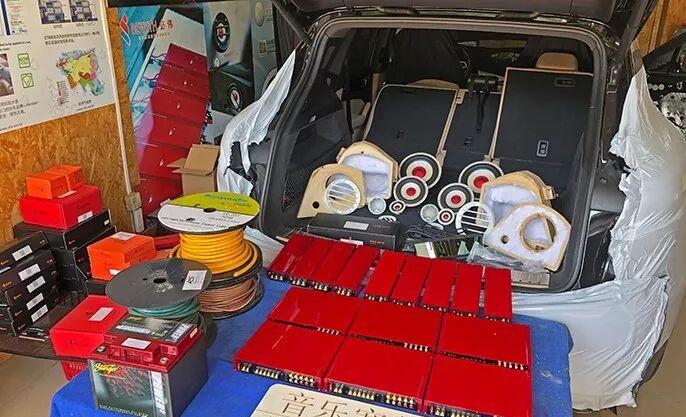
Wise modification lies in understanding the principle behind every investment and choosing “useful materials” that can really solve the problem, rather than blindly following the trend. In the subject of “electricity”, investing in high-quality sources is often the most cost-effective “shortcut”.

You May Also Like
Beyond the original factory: Mercedes-Benz S 450 uses Biwei Blue Core for secondary audio creation, demonstrating the art of dual-system acoustic superposition
The ultimate pursuit of vocal restoration: In-depth evaluation of Biwei A series two-way frequency, exploring the king logic behind mica diaphragm and precise transmission