The engineering revolution from hustle and bustle to tranquility: a full analysis of Toyota Corolla’s deep sound insulation solution
The original intention of implementing sound insulation and noise reduction projects for your cars mostly stems from car owners’ pursuit of higher-quality driving experience-their desire to open up a quiet, focused and comfortable mobile private space for themselves in the hustle and bustle of roads and busy cities. However, the word “sound insulation” seems simple, but its connotation is quite different, and its effect is divided into “three, six and nine grades”. This difference is not only reflected in the physical properties of the selected sound insulation materials themselves (such as damping coefficient, density, environmental protection, weather resistance), but also deeply depends on the technical foundation and experience accumulation of the construction team. An experienced technician can accurately judge the source and characteristics of noise in different parts, and apply the most suitable materials and processes; Rough construction, even if top-level materials are used, may get twice the result with half the effort, and even bring new abnormal noises. Therefore, choosing sound insulation is essentially choosing a set of systematic solutions that combine “material science” with “craft art”.
Below, we will show in detail how a rigorous and systematic sound insulation solution is implemented through an example of a Toyota Corolla’s entire car sound insulation. The core material of this project is Japanese Flute God series sound insulation products with good reputation in the industry. Our construction plan has been carefully designed, paying special attention to sound insulation in the chassis area, and adopting a “three-layer composite structure” treatment to cope with complex road noise and vibration. The specific sound insulation parts cover almost all the main incoming paths of vehicle noise, including: * * chassis girder * * with load-bearing structure * *, * * five doors * * as the weak link of noise * *, * * hood * * that isolates high-frequency engine noise * *, * * rear trunk * * that is easy to generate low-frequency resonance * *, * * front wheel fender * * and * * tire liner * * directly facing tire rolling noise * *, and finally, * * five-door special sealing strips * * are installed to improve air tightness and block wind noise. This is an all-round encirclement and suppression campaign from the source to the transmission path.
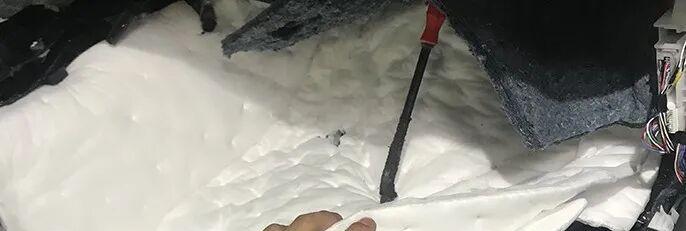
Step 1: Comprehensive and detailed disassembly
Professional sound insulation begins with respect and protection of the original car. We first perform an orderly and discreet disassembly of the entire vehicle interior parts before commencing any construction. This includes seats, carpets, door panel moldings, ceilings, etc. The figure shows the state after disassembly, exposing the original metal skeleton of the vehicle, which is the basic plane of all subsequent sound insulation work. Only thorough exposure can ensure that every inch of the area that needs sound insulation is covered, and the material is pasted firmly and smoothly.


Step 2: Filling treatment of structural cavity
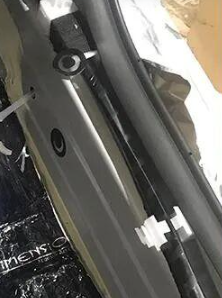
Large hollow structures such as longitudinal beams and cross beams on the vehicle chassis can easily resonate and amplify noise like “speakers” during driving. We use special damping and shock-absorbing materials or foaming fillers to carry out targeted treatment on the inside of these girders to change their resonance characteristics and structurally weaken the generation and transmission of low-frequency roar.
Step 3: Deep Sound Insulation of Wheel Arch Areas
Road noise caused by friction and vibration between tires and the ground is one of the most important noise sources in cars. We fill the inside of the * * front wheel fenders * * and adhere sound insulation to the removable * * tire liners * * on both the inside and outside. This “internal and external attack” method can absorb and block the broadband noise (including high-frequency friction sound and medium-and low-frequency vibration sound) generated when tires roll to the greatest extent.
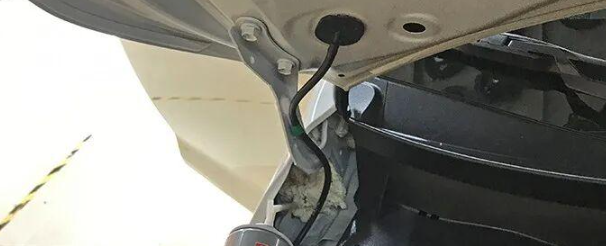
(Internal filling of fender)
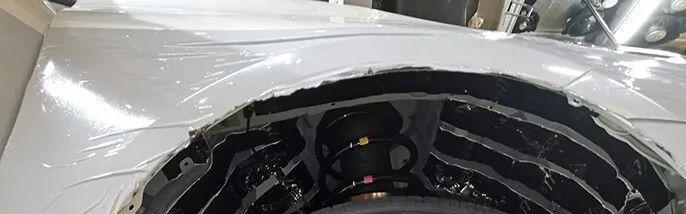
(Front wheel sound insulation construction)
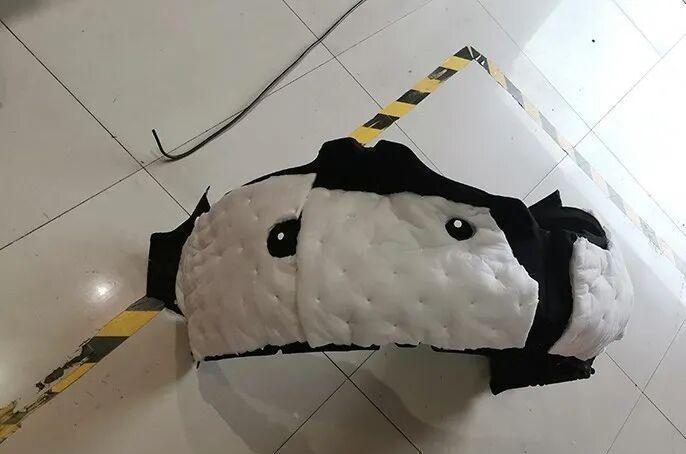
(tire liner sound insulation)
Step 4: Linkage upgrade of sound system
It is worth noting that this soundproof car owner also simultaneously carried out an extremely cost-effective audio upgrade. He chose high-quality * * used front door horns * * upgraded and replaced by other customers. Installing these speakers in the doors that have been soundproofed to create a better acoustic environment (“cabinet”) can achieve far higher sound quality improvements than the original car at a lower cost. We matched it with a * * DSP power amplifier * *, which not only provides driving power, but also finely tunes the sound through digital signal processing, making up for the minor differences that may exist in second-hand speakers and making them perform at their best.
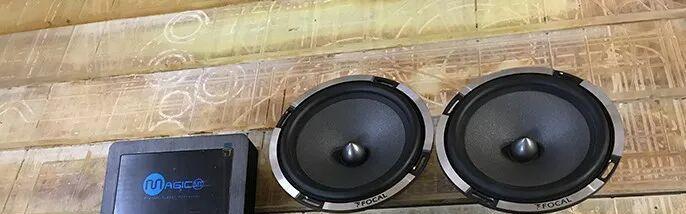
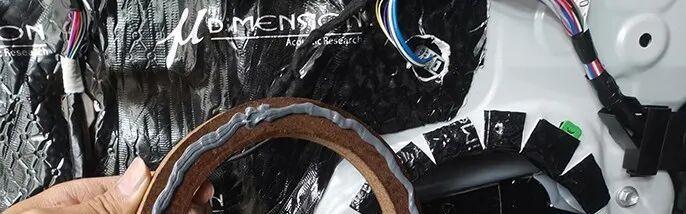
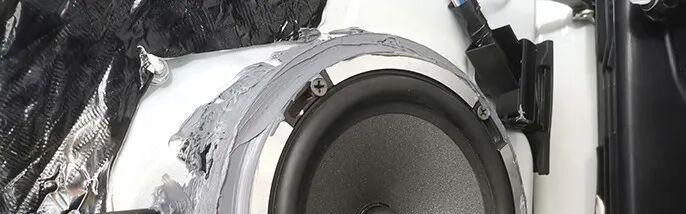

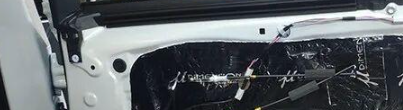

(DSP power amplifier for driving and tuning)
Step 5: Perfect treatment of trunk and hood
* * The rear trunk * * is another huge source of cavity resonance, especially the “hardest hit area” of low-frequency noise. We have comprehensively covered the floor plate, the inner sides of the wheel arches on both sides and the rear fender with shock absorption and sound absorption to effectively suppress resonance and greatly improve the quietness of the rear of the vehicle. * * Hood * * Sound insulation is mainly pasted with fireproof sound insulation cotton, which can not only suppress the direct radiation of high-frequency noise of the engine, but also play a certain thermal insulation protection role on the paint surface.

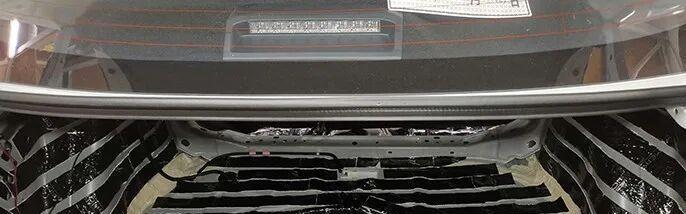


(Details of sound insulation construction of rear trunk)
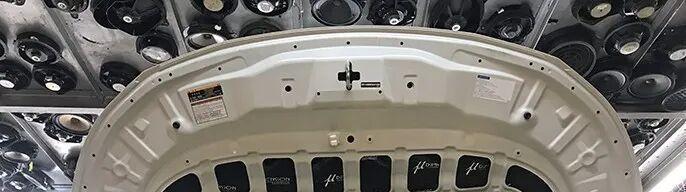
(Hood sound insulation finish effect)
Through the above systematic construction from the inside out, from the structure to the surface, this Toyota Corolla has successfully realized the transformation from a “means of transportation” to a “quiet cockpit”. It not only significantly reduces road noise, wind noise and engine noise during driving, but also lays an excellent acoustic foundation for subsequent audio upgrades (even second-hand speakers), fully proving the value of professional sound insulation solutions.


You May Also Like

Master-level “subtraction” art: in-depth transformation of Yueda Kia audio, an acoustic magic internal strength and mental method in a small space
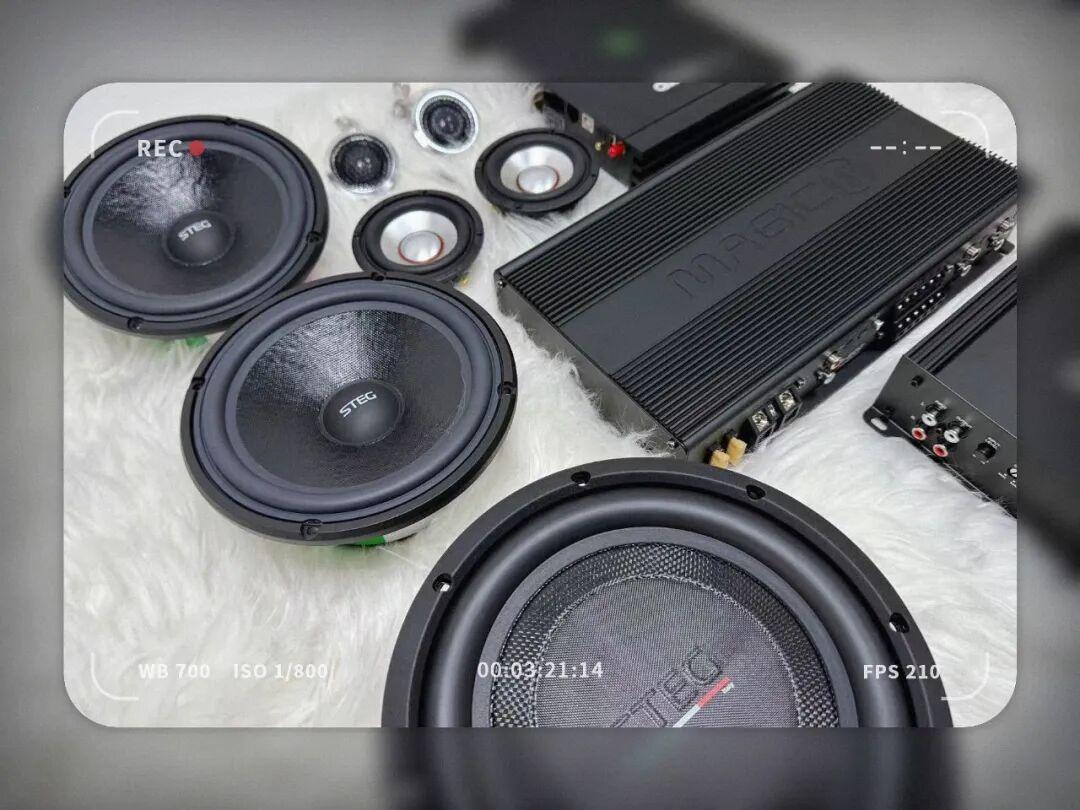
How did Steiger three-way package become the best seller of music broadband of the year?